

| Construction sector – Glenigan Index figures indicate that the construction sector is stuck in neutral | Hotel sector – UK hotel investment volumes reached approx. £2.1bn in the first half of 2026 | Property sales – The number of council homes sold under the Right to Buy scheme increased by 90% in 2025 |
Construction sector stuck in neutral
The latest Glenigan Index indicates that the construction sector is stuck in neutral and struggling to regain momentum.
In the three months to the end of July, the value of work starting on-site declined by 11% and was 29% lower than last year’s levels. Residential construction starts also saw a drop, falling by 25% when compared with the preceding three months, a 46% reduction versus 2025 levels.
It seems the overall construction sector is being impacted by ongoing global conflict and domestic political change, with plans at risk of being halted and private investors unsure about releasing investment capital.
Yuliana Ivanykovych at Glenigan commented, “Try as it might, the sector continues to be held back by external factors beyond its control, with a changing of the guard at the top of government being the latest in a string of extraordinary events.”
Right to Buy reforms on the horizon
As Right to Buy reforms make their way through Parliament, analysis shows that more homes are being sold under this scheme.
During 2025-26, the number of council homes sold under the Right to Buy scheme increased by 90% when compared with 2024-25. As a result, local authorities received £1.61bn from Right to Buy sales, up 99.6% on the previous year.
Overall, there have been over two million sales since the Right to Buy scheme was established in 1980. While this is positive for helping people become homeowners, it has affected the social housing supply. Therefore, Starmer’s Labour Government announced in April that it will bring forward reforms to the scheme in order to better protect and rebuild depleted housing stock. The minimum qualifying period to apply for the Right to Buy scheme will increase from three to ten years. Also, newly built social homes will not be sold under the scheme for 35 years.
Activity lags in Devon and Cornwall
Sales activity in Devon and Cornwall has not picked up despite holiday let reforms.
Since April 2025, local authorities in England have been able to charge a Council Tax premium of up to 100% on second homes. This policy was designed to increase the availability of properties for local residents and deter holiday homeowners. While some holiday let owners have put their property on the market, it seems that this reform has not yet boosted the local property markets.
According to property marketplace LandSale, there are an estimated 10,334 properties on the market in England that are suitable as holiday lets. 51.2% of these are in the South West, with Cornwall and Devon particularly popular destinations.
However, between 2024 and 2025, residential transaction volumes only increased by 3.7% in Cornwall and 1.5% in Devon. This is lower than the national average of 4.4%, indicating that the Council Tax premiums have not yet translated into stronger market performance.
Office sector update
Data from CBRE shows that Artificial intelligence (AI) firms are helping to drive demand for office space in Central London.
Occupier demand was strong in the office sector in the first half of 2026. Take-up in Central London was broadly in line with last year’s levels, supported by technology, media and telecommunications occupiers. By the end of H1, AI-related office take-up reached 705,371 sq. ft – four times higher than in H1 2025 and more than double the full-year total for 2025. Two of the largest transactions involved OpenAI and Anthropic.
In Central London, limited availability of Grade A office space has driven up rents, which reached £95 per sq. ft in prime City locations – 12% higher than the previous year. In Q2, newly completed and pre-let space accounted for only 36% of take-up. This is the lowest combined share since 2020, thus highlighting the ongoing supply shortage. Meanwhile, regional markets are benefitting from growing demand in the defence and cybersecurity sectors.
Hotel investment market
According to Savills, UK hotel investment volumes reached approximately £2.1bn in the first half of 2026 – nearly £500m higher than the same period in 2025.
London led the way in H1, attracting £1.4bn of investment – this was driven by sustained interest in single asset transactions. The strength of the capital’s hotel investment market can be attributed to the availability of core capital, strong trading fundamentals and liquidity.
Investors were active in select regional markets that offered compelling yields and strong revenue performances, with significant transactions in Edinburgh, Oxford City Centre and Reading. Savills notes that investor activity is focused on locations with clear operational fundamentals, resilient leisure and corporate demand, plus the potential to capture income growth.
David Kellett at Savills commented, “The UK hotel sector continues to benefit from strong operational fundamentals and a deep pool of capital, supporting a positive outlook for best-in-class assets and high performing regional markets.”
Low supply of retail parks
The latest data from Savills shows there is a shortage of space in retail parks. Retail park vacancy rates have hit a record low, with only 1.8% of the total floor space currently available in the UK.
Meanwhile, British Land (one of the largest retail park owners) has a 99% occupancy rate. This comes at a time when retailers are turning their attention to shops after focusing on online shopping. Kelly Cleveland at British Land explained, “Retail parks are outperforming because they offer what both retailers and customers need today: affordability, accessibility and adaptability.”
With 91% of retailers renewing their leases, new developments are struggling to keep up with the high demand because it has become increasingly expensive and time-consuming to secure planning permission. Johnny Rowland at Savills advised, “The only new development we’re going to see will be small two- or three-unit schemes, and typically anchored by food stores.”
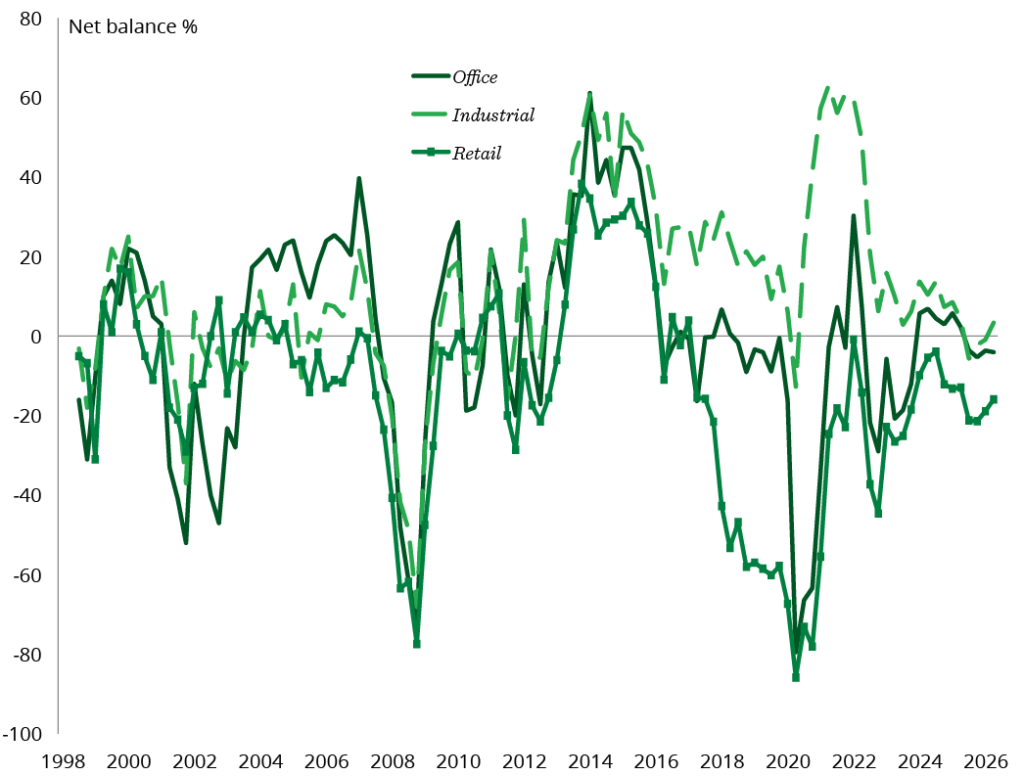
Occupier demand – broken down by sector
- On a UK-wide basis, the all-sector occupier demand indicator returned a net balance of -5%
- Industrial demand strengthened, with the net balance rising to +3% from -1% previously
- In retail, the latest net balance of -16% remains the weakest.
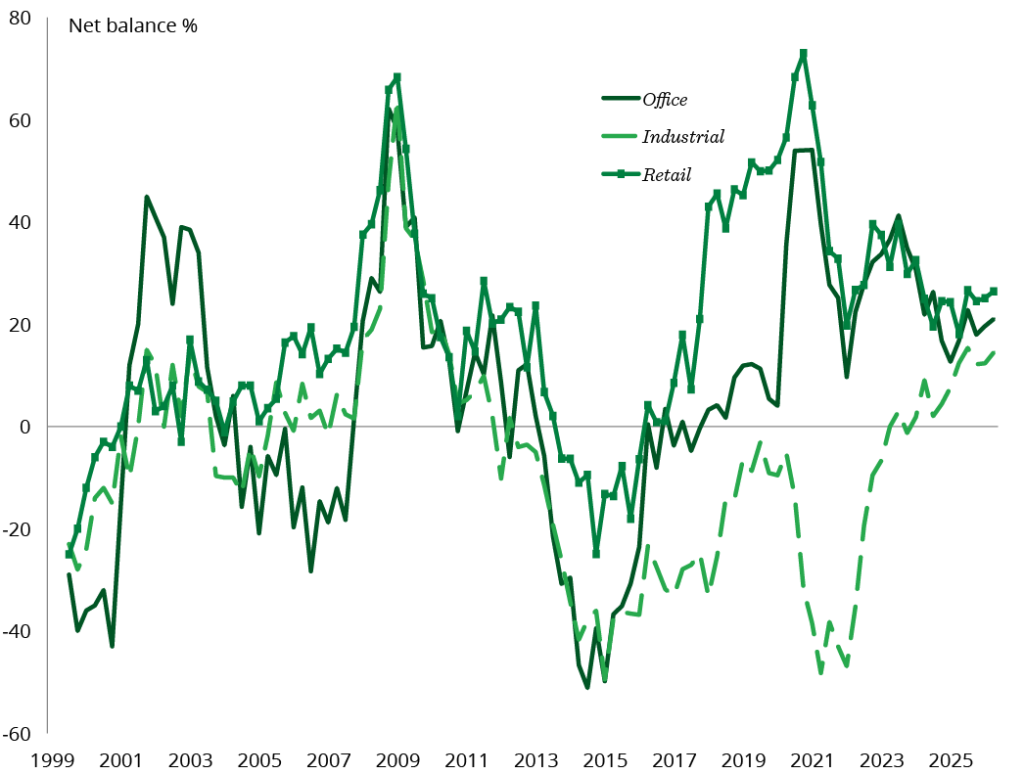
Availability – broken down by sector
- The net balance for availability of +20% points to a modest increase in vacancies during Q2
- Respondents reported a rise in the volume of unlet space across all three traditional sectors
- Landlords are continuing to offer significant incentives to attract occupiers.
All details are correct at the time of writing (19 August 2026)
It is important to take professional advice before making any decision relating to your personal finances. Information within this document is based on our current understanding and can be subject to change without notice and the accuracy and completeness of the information cannot be guaranteed. It does not provide individual tailored investment advice and is for guidance only. Some rules may vary in different parts of the UK
